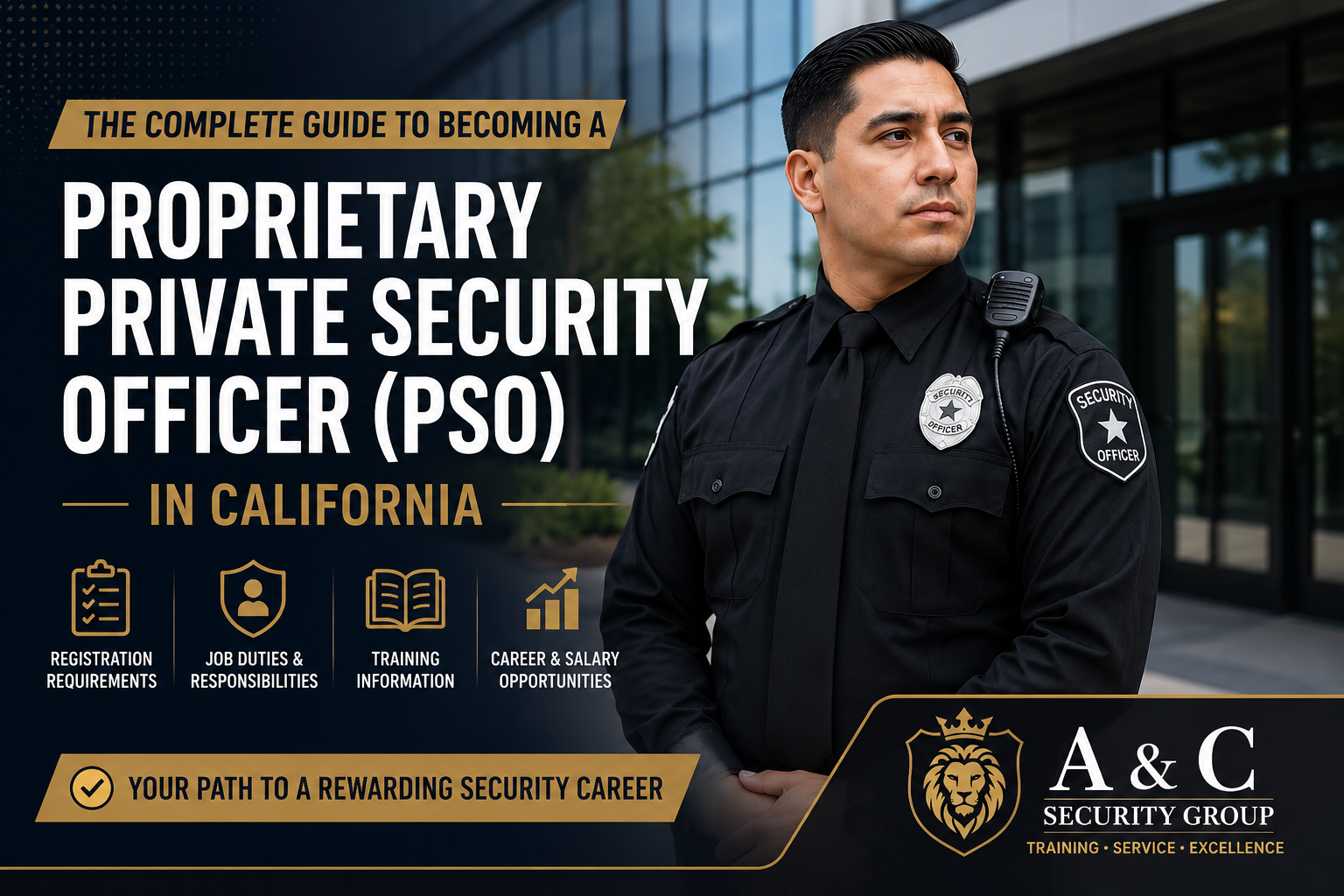
A Proprietary Private Security Officer (PSO) is a security professional who works directly for one employer and helps protect that employer’s people, property, and assets. Unlike security guards employed by security companies, a PSO provides security services only for the company that hires them.
Many people assume a Proprietary Private Security Officer (PSO) is simply another name for a security guard. However, California law treats these positions differently.
A Proprietary Private Security Officer is usually unarmed and works only for one employer. They provide security services only for that employer.
To qualify as a Proprietary Private Security Officer, the individual is generally expected to:
- Work exclusively for one employer
- Provide security services for that employer
- Wear a distinctive uniform identifying them as security personnel
- Regularly interact with the public while performing assigned duties
Examples of businesses that commonly employ PSOs include:
- Hospitals
- Hotels
- Apartment communities
- Warehouses
- Manufacturing facilities
- Retail stores
- Corporate offices
- Educational facilities
Because PSOs often serve as the first contact for visitors, customers, vendors, and employees, professionalism is important. Strong communication skills are also key.
PSO vs Guard Card: Understanding the Difference
One common question from applicants is whether they need a Proprietary Private Security Officer registration.
Others ask if they need a Security Guard registration, often called a Guard Card.
The answer depends on who employs you.
A Proprietary Private Security Officer works directly for one employer.
They protect only that employer’s property, employees, and assets.
A Security Guard usually works for a licensed private patrol operator or security company.
They may be assigned to multiple client locations.
Choosing the correct registration is important because applying for the wrong credential can create delays in employment and licensing.
How to Apply for a Proprietary Private Security Officer Registration
The Bureau of Security and Investigative Services (BSIS) oversees the registration process for Proprietary Private Security Officers in California.
The registration process generally includes:
- Meeting minimum eligibility requirements.
- Completing required training.
- Submitting fingerprints through Live Scan.
- Filing the appropriate application.
- Waiting for background check and registration approval.
Applicants should carefully review all instructions before submitting paperwork to help avoid unnecessary delays during application processing.
How Long Does It Take to Receive a PSO Registration?
Processing times vary based on application volume, fingerprint processing, background check completion, and application accuracy.
Submitting complete and accurate information can help reduce delays.
Many applicants find that completing Live Scan promptly and ensuring all information is correct helps move the process along more efficiently.
Annual Training Requirements for PSOs
Training does not end once a Proprietary Private Security Officer receives registration.
California requires ongoing education and professional development to help ensure officers remain knowledgeable regarding safety procedures, legal responsibilities, communication techniques, and security-related duties.
Continuing education helps PSOs stay current with industry expectations while improving their ability to respond effectively to situations encountered on the job.
Common Mistakes New PSO Applicants Make
Individuals applying for a Proprietary Private Security Officer registration often encounter delays due to avoidable mistakes.
Common issues include:
- Submitting incomplete applications
- Waiting too long to complete Live Scan fingerprinting
- Providing inaccurate information
- Confusing PSO registration with a Guard Card
- Failing to maintain required training records
Taking time to understand the registration process can help applicants avoid unnecessary setbacks and begin their security careers sooner.
What Does a Proprietary Private Security Officer Do?
A Proprietary Private Security Officer (PSO) is responsible for helping maintain a safe and secure environment for the employer they serve. Unlike contract security guards who work at many client sites, a PSO works only for one employer.
They focus on protecting the organization’s people, property, and assets.
Daily responsibilities may vary depending on the industry and work environment, but common duties often include:
- Monitoring entrances and exits
- Conducting foot patrols
- Observing and reporting suspicious activity
- Monitoring security cameras and alarm systems
- Assisting visitors and employees
- Documenting incidents and accidents
- Enforcing company policies
- Responding to emergencies
- Reporting safety hazards
- Assisting law enforcement or emergency responders when necessary
Many Proprietary Private Security Officers also serve as customer-facing representatives for their employer. Because of this, communication skills, professionalism, and good judgment are important qualities for success in the role.
Industries That Commonly Employ Proprietary Private Security Officers
Proprietary Private Security Officers can be found in many industries throughout California.
Employers often choose to hire in-house security personnel when they want greater control over security operations and employee accountability.
Common industries that employ PSOs include:
Healthcare Facilities
Hospitals, clinics, and medical campuses frequently use security personnel to monitor access points, assist visitors, and help maintain a safe environment for patients and staff.
Apartment Communities
Residential communities often employ security officers to patrol grounds, monitor parking areas, investigate disturbances, and assist residents.
Retail Stores
Retail businesses may utilize proprietary security officers to deter theft, monitor customer activity, and support loss prevention efforts.
Hotels and Hospitality
Hotels frequently rely on security personnel to protect guests, employees, and property while responding to incidents and emergencies.
Warehouses and Distribution Centers
Large facilities often require security personnel to monitor access control, vehicle traffic, inventory protection, and employee safety.
Manufacturing Facilities
Manufacturing operations may employ proprietary security officers to secure equipment, facilities, and restricted areas.
Benefits of Becoming a Proprietary Private Security Officer
For many individuals, becoming a Proprietary Private Security Officer can be an excellent entry point into the security industry.
Some benefits include:
Consistent Work Environment
Unlike contract security guards who may be assigned to multiple locations, PSOs often remain at a single facility or campus.
Opportunity to Build Relationships
Working for one employer allows officers to become familiar with employees, management, policies, and facility operations.
Career Advancement Opportunities
Many employers promote experienced security personnel into lead officer, supervisor, manager, safety coordinator, or loss prevention positions.
Valuable Professional Experience
Experience gained as a Proprietary Private Security Officer can help individuals pursue future opportunities in security management, investigations, emergency preparedness, corporate security, or other related fields.
Skills Every Successful PSO Should Develop
Training is important, but the most successful Proprietary Private Security Officers continue developing their professional skills throughout their careers.
Key skills include:
Observation Skills
Security officers must be able to recognize unusual activity, identify potential threats, and notice important details that others may overlook.
Communication Skills
Clear communication is essential when interacting with the public, documenting incidents, and coordinating with supervisors or emergency personnel.
Conflict Resolution
Security officers frequently encounter difficult situations. Remaining calm and professional can help prevent situations from escalating.
Report Writing
Accurate documentation is one of the most important responsibilities of security personnel. Well-written reports help employers document incidents, investigations, and safety concerns.
Professionalism
A professional appearance, positive attitude, and strong work ethic can significantly impact career growth opportunities within the security industry.
How Much Does a Proprietary Private Security Officer Make?
One of the most common questions people ask before entering the security industry is how much a Proprietary Private Security Officer (PSO) can earn.
Pay varies depending on several factors, including:
- Geographic location
- Industry
- Employer
- Experience level
- Shift assignment
- Additional training and certifications
In California, many entry-level security positions provide an opportunity to gain valuable experience while developing important workplace skills. Individuals who demonstrate professionalism, reliability, strong communication skills, and leadership potential may have opportunities to advance into higher-paying roles.
Some employers promote experienced officers into positions such as:
- Lead Security Officer
- Security Supervisor
- Security Manager
- Loss Prevention Specialist
- Safety Coordinator
- Corporate Security Officer
As security professionals gain experience and additional training, they may qualify for greater responsibilities and career advancement opportunities.
How Long Does It Take to Become a Proprietary Private Security Officer?
The amount of time required to become a Proprietary Private Security Officer depends on several factors.
These factors may include:
- Completion of required training
- Live Scan fingerprint processing
- Background check review
- Application accuracy
- Registration processing times
Applicants who complete training promptly and submit accurate paperwork can often avoid unnecessary delays.
Before applying, individuals should carefully review all requirements to ensure their application is complete and accurate.
Common Mistakes New PSO Applicants Make
Many application delays can be avoided by understanding the registration process before applying.
Some of the most common mistakes include:
Applying for the Wrong Registration
Some individuals mistakenly apply for a Guard Card when their employer requires a Proprietary Private Security Officer registration.
Delaying Live Scan Fingerprinting
Waiting too long to complete fingerprinting can delay the application process.
Submitting Incomplete Applications
Missing information can slow registration processing and require additional follow-up.
Not Understanding Training Requirements
Applicants should familiarize themselves with all required training and continuing education obligations before beginning work.
Failing to Keep Records
Maintaining copies of training certificates and application documents can help resolve issues if questions arise later.
Frequently Asked Questions About Proprietary Private Security Officers (PSOs)
What Is a Proprietary Private Security Officer (PSO)?
A Proprietary Private Security Officer (PSO) is a security professional who works directly for a single employer and helps protect that employer’s people, property, and assets. Unlike contract security guards, PSOs do not provide security services to outside businesses or clients.
What Is the Difference Between a PSO and a Security Guard?
A PSO works directly for one employer, while a security guard is typically employed by a licensed private patrol operator or security company. Security guards may work at multiple client locations, while PSOs generally protect only the property of their employer.
Does a PSO Need a Guard Card?
A Guard Card and a Proprietary Private Security Officer registration are different credentials. The registration required depends on the employer and the type of security work being performed.
Can a PSO Carry a Firearm?
A Proprietary Private Security Officer registration by itself does not authorize an individual to carry a firearm while performing security duties. Additional permits, training, and legal requirements may apply depending on the position.
Can a PSO Carry Pepper Spray?
Carrying pepper spray may be subject to additional laws, employer policies, and training requirements. Individuals should review applicable laws and employer requirements before carrying any defensive tools.
Can a PSO Make Arrests?
Security personnel must understand the limits of their authority. Training in Power to Arrest helps security officers understand when and how they may lawfully detain or arrest individuals under applicable laws.
Does a PSO Wear a Uniform?
Yes. California generally requires Proprietary Private Security Officers to wear a distinctive uniform while performing their duties. The uniform helps identify the individual as security personnel and distinguish them from law enforcement officers.
Can a PSO Interact With the Public?
Yes. Many PSOs regularly interact with employees, customers, visitors, vendors, and members of the public while performing security-related duties.
Do PSOs Need Training?
Yes. California requires specific training for Proprietary Private Security Officers. Training helps officers understand their responsibilities, legal limitations, safety procedures, and professional conduct expectations.
How Long Does It Take to Become a PSO?
The timeline can vary depending on training completion, fingerprint processing, background checks, and registration approval times.
How Long Does a PSO Registration Last?
Registration periods and renewal requirements may change over time. Applicants should review current requirements to ensure compliance with applicable regulations.
What Jobs Can a PSO Get?
Many industries employ Proprietary Private Security Officers, including:
- Hospitals
- Hotels
- Retail stores
- Apartment communities
- Warehouses
- Manufacturing facilities
- Office buildings
- Educational institutions
Can a PSO Work for Multiple Employers?
A Proprietary Private Security Officer generally works directly for a single employer rather than providing contract security services to multiple clients.
Is a PSO an Armed Security Officer?
Not necessarily. Most Proprietary Private Security Officers perform unarmed security duties unless they have obtained additional permits, authorizations, and training.
What Skills Are Important for a PSO?
Successful security officers often possess:
- Strong observation skills
- Good communication abilities
- Professionalism
- Attention to detail
- Report-writing skills
- Conflict-resolution abilities
- Customer service skills
Why Do Companies Hire Proprietary Private Security Officers?
Many employers prefer in-house security personnel because they are familiar with company policies, facility operations, employees, and security procedures.
What Industries Hire the Most PSOs?
Industries commonly hiring Proprietary Private Security Officers include healthcare, retail, hospitality, residential communities, manufacturing, logistics, and commercial real estate.
Can a PSO Become a Security Guard Later?
Many individuals begin their careers as Proprietary Private Security Officers and later pursue additional training or licensing opportunities within the security industry.
Is a Career as a PSO Worth Considering?
For individuals interested in safety, security, customer service, and professional growth, becoming a Proprietary Private Security Officer can offer valuable experience and opportunities for advancement.
Where Can I Learn More About Security Training in California?
Individuals interested in pursuing a career in security should research current state requirements, employer expectations, training programs, and registration requirements before applying.
Why Employers Choose Proprietary Private Security Officers
Security is an important part of protecting people, property, equipment, and business operations. While some organizations hire contract security services, others choose to employ Proprietary Private Security Officers (PSOs) directly.
There are several reasons employers choose in-house security personnel.
Greater Familiarity With the Property
A Proprietary Private Security Officer works exclusively for one employer. Over time, officers become familiar with the facility layout, company policies, employee schedules, access points, and potential security concerns.
This familiarity can help officers recognize unusual activity more quickly and respond more effectively to incidents.
Consistent Security Presence
Because PSOs typically remain with one employer, they often develop strong working relationships with employees, supervisors, and management.
A consistent security presence can improve communication, increase accountability, and help create a safer work environment.
Improved Customer and Visitor Experience
Many Proprietary Private Security Officers serve as the first point of contact for visitors, vendors, customers, and guests.
Professional security personnel can provide directions, answer questions, assist with access procedures, and help create a positive first impression of the organization.
Support During Emergencies
Security personnel often play an important role during emergencies.
Depending on company policies and job responsibilities, officers may assist with:
- Building evacuations
- Emergency notifications
- Access control
- Incident documentation
- Coordination with emergency responders
- Safety and security procedures
Well-trained security personnel can help organizations respond more effectively during unexpected situations.
Protection of Company Assets
Businesses invest significant resources into facilities, equipment, inventory, technology, and intellectual property.
Security officers help deter theft, vandalism, unauthorized access, and other activities that may negatively impact business operations.
Long-Term Career Development
Many employers view security positions as an opportunity to develop future leaders within their organizations.
Experienced officers may advance into positions such as:
- Lead Security Officer
- Security Supervisor
- Security Manager
- Loss Prevention Specialist
- Safety Coordinator
- Corporate Security Officer
For individuals interested in professional growth, a Proprietary Private Security Officer position can serve as a strong foundation for a long-term career in security, safety, and risk management.
Start Your Security Career in California
If you’re interested in working in the security industry, understanding the requirements for a Proprietary Private Security Officer registration is an important first step.
Whether you are exploring your first security job or researching other career paths, proper training helps.
Learning California’s requirements can also help you prepare for future opportunities.
At A & C Security Group, we provide security training for students.
Our training helps students understand industry requirements and prepare for security careers.
Additional services and training opportunities may include:
- Security Guard Training
- Power to Arrest Training
- Live Scan Fingerprinting
- Firearms Training
- Pepper Spray Training
- Continuing Education Courses
By learning the registration process, training needs, and career options, you can make informed choices. As you begin your journey into California’s private security industry.
Ready to learn more? Explore our security training programs and resources to take the next step toward your security career.